Guides / How to measure a sprocket with a caliper
How to measure a sprocket with a caliper
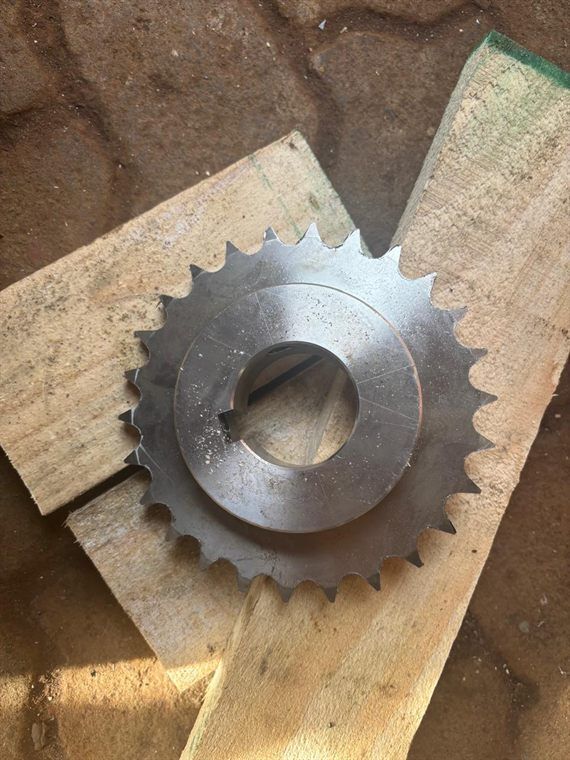
A worn sprocket comes in, no markings, no drawing, and you need to make another one. With a caliper and five minutes you can find out exactly what it is. This is the sequence we use in the shop.
1. Count the teeth (N)
It sounds obvious, but it is the most common mistake. Mark one tooth with chalk or a marker and count until you get back to it. On large sprockets, count twice. Note whether the number is even or odd, because it changes how you measure.
2. Find the pitch
If you have the chain, measure over several links: from the left edge of one roller to the left edge of another roller 10 rollers away, then divide by 10. A 0.004" caliper error becomes 0.0004" per pitch. Standard pitches are 1/4", 3/8", 1/2", 5/8", 3/4", 1", 1¼", 1½", 1¾", 2", 2½" and 3".
If you only have the sprocket, the pitch follows from the diameters: with the readings from steps 3 and 4, the sprocket identifier tells you which chain fits.
3. Measure over the tips
With an even tooth count the teeth face each other: measure tip to tip. With an odd count there is a gap opposite every tooth, so the caliper reads a slightly smaller value than the true outside diameter (multiplied by the cosine of 90°/N).
This reading is useful to get your bearings, but it is not the most reliable: tips wear, and each manufacturer turns them to a slightly different diameter within the standard. For a 20-tooth #40 sprocket, ANSI gives a turned OD of about 3.457" (87.80 mm).
4. Measure root to root: the reading that matters
The tooth root barely wears and its size is fixed by the standard: pitch diameter minus roller diameter. Rest the outside jaws of the caliper on the bottom of two opposite tooth gaps.
| Sprocket | Pitch dia. | Root to root | How to measure |
|---|---|---|---|
| #40, 20 teeth (even) | 3.196" | 2.884" | Opposite gaps: bottom dia. = PD − roller |
| #40, 21 teeth (odd) | 3.355" | 3.034" | To the most opposite gap: PD·cos(90°/N) − roller |
| 08B, 20 teeth | 3.196" | 2.861" | Same pitch as #40, larger roller |
Look at the two 20-tooth rows: the American and the European sprocket have the same pitch diameter, but the root differs by 0.023" (0.59 mm). A caliper picks that up easily, and it is the quickest way to know whether the sprocket is for ANSI or European chain. More in 08B vs ANSI 40.
5. Measure tooth width, hub and bore
- Tooth width at the base (not at the tip, which is chamfered). For a #40 simplex it is around 0.287".
- Hub: diameter and overall length. The hub diameter has a maximum so the chain doesn't rub on it.
- Bore and keyway: shaft diameter, keyway width and depth. If there is a set screw, its thread and position.
- Duplex or triplex: also measure the distance between tooth rows (transverse pitch).
6. Spot the wear
A healthy tooth is symmetrical. A worn tooth is hooked: the working face wears away and the tip leans in the direction of rotation. You also see polished roots and burred tips. If the sprocket looks like that, the chain is almost certainly stretched: measure it (over 2–3% elongation it must be replaced) and replace both together; a new chain on a worn sprocket won't last.
With those readings, you can make it
With tooth count, pitch and chain type, the sprocket calculator gives you every dimension to turn and inspect, the stock size, and a DXF of the tooth profile for cutting. And if you are torn between two chains, the identifier compares your readings against every standard.